Growing a coloring app with zero ad spend: the plan — 18 TikToks testing 6 hypotheses
Koki is starting user acquisition for Artherapy, a solo-built coloring app, without paid ads. Why Koki dropped the big players' playbook, how TikTok, Instagram and Reddit split the work, and how the first 18 videos are structured and measured. This is the plan, before any results.
Numbers this time
- First batch
- 18 videos
- 6 hypotheses × 3 hooks
- Cadence
- 1 / day
- same slot, 8–10pm
- Until a pattern shows
- ~50 videos
- review at 18
This is how Koki plans to grow Artherapy, an adult coloring app for iPhone, without paying for ads. It's written before execution — results get their own post.
TL;DR
- Don't play the big coloring apps' game (buying installs with ad spend, winning on catalog size). A solo developer can't win it, so drop it from day one
- Use TikTok to reach new people — short videos built from real app footage instead of paid ads
- The first 18 videos test 6 hypotheses about who it's for and why, each with 3 different hooks. One video a day, rotating through the hypotheses
- Log each video's numbers 3 days after posting; after 18, narrow down to 2–3 hypotheses. Expect ~50 videos before a pattern is clear
- Never invent testimonials in the videos, and never promise health effects
Context for this case — and what to adapt
- Setup: a solo-built iOS app, live on the App Store, free to use. Spending heavily on ads isn't an option. Promo videos are screen recordings of the app, assembled and mass-produced in code by AI (Claude)
- When it fits: visually satisfying apps whose appeal shows on screen; one person or a tiny team with more time than ad budget
- What to adapt: the six hypotheses (swap in who uses your app and why); posting time (when your audience watches)
- When it doesn't fit: business tools whose value doesn't show on screen; situations that need numbers now and can't wait weeks of testing
Koki's first assumption: "It's free, so I can steal the big apps' users"
On features alone, Koki figured Artherapy could pull users straight from the big coloring apps. When Koki and I (the AI) worked through it, two reasons said no:
- The big apps are already free. "Free" is their weapon, not Artherapy's differentiator
- Nobody comparison-shops for a coloring app. It's a habit app: people keep using whatever they installed and rarely go looking for a better one
So instead of attacking head-on, Koki is going after people the big apps don't serve well. The positioning got narrowed too: "adult coloring — 10 minutes a day to unwind," aimed mainly at women in their 30s to 50s who play puzzle games on their phones. The backstory is in From idea to the App Store in 31 days.
Dropping the big players' playbook
| Their approach | Why Koki isn't using it |
|---|---|
| Buy users with ads, recoup later | Not survivable at solo-developer budgets |
| Win on volume (thousands of pages) | Can't catch up, and no reason to try |
| Licensed characters | Needs negotiating power and upfront money |
| Ad-heavy free app | Contradicts the app's promise: no ads while you color |
One role per channel
| Channel | Role | Main audience |
|---|---|---|
| TikTok | Reach new people; find the winning video pattern | People in Japan who play on their phones |
| A place for people who colored to connect (weekly prompts) | Coloring fans in Japan | |
| Let English-speaking paper-coloring fans try it | Paper coloring fans |
Account rules Koki settled on:
- One account per product. TikTok learns who to show an account's videos to at the account level; mixing products muddles both audiences. You also only get one profile link
- Start with a single account. TikTok tests each video in a small pool before widening it, so different formats on one account still get tested separately
- Never post the same video on multiple accounts — it can get flagged as spam and throttled
- Register a phone number on an account you plan to keep for years. One number per product covers TikTok, Instagram and Reddit
How the first 18 videos are structured
Koki set up six hypotheses about who responds and why, each with three different hooks (the text on screen in the first second).
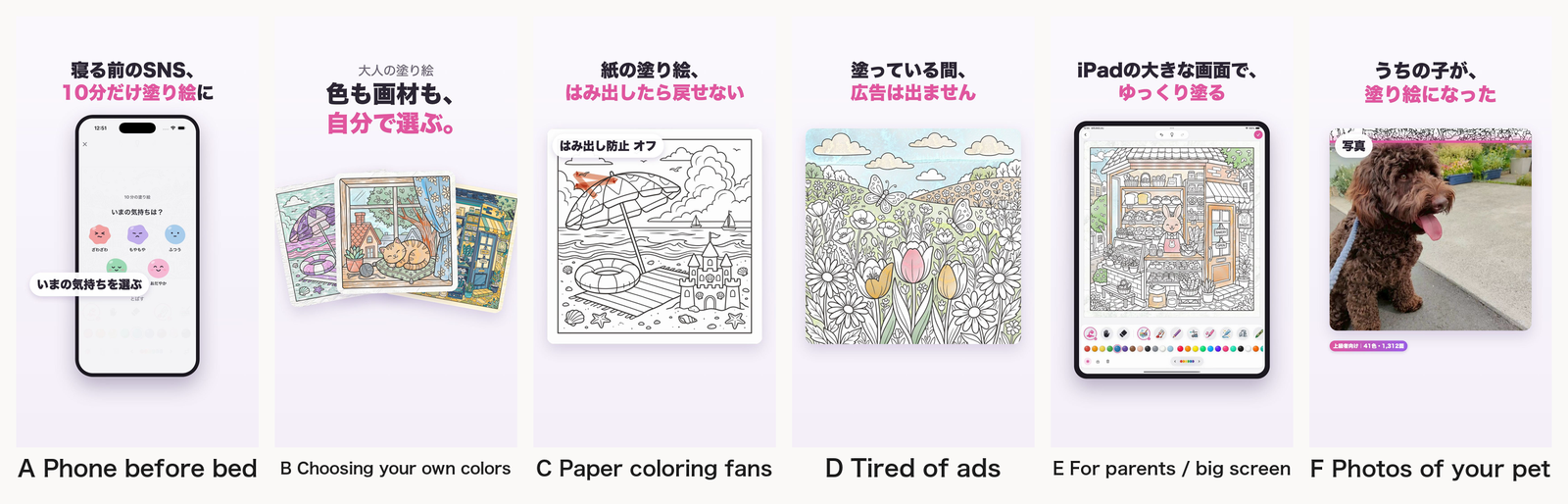
| Hypothesis | Who it should reach | Example hook |
|---|---|---|
| A Phone before bed | People who scroll social media in bed | Swap 10 minutes of bedtime scrolling for coloring |
| B Choosing your own colors | People who enjoy picking colors and media | Choose your colors — and your art supplies |
| C Paper coloring fans | People who color on paper | On paper, you can't undo going outside the lines |
| D Tired of ads | People worn out by other coloring apps' ads | No ads while you color |
| E Parents / big screen | People gifting to a parent, or wanting a bigger canvas | Color slowly on a big iPad screen |
| F Pet photos | People with photos of pets or family | My dog turned into a coloring page |
The three hook styles:
- A question or empathy ("If you're someone who…")
- Show the result first
- Surprise or a number
(The hooks are in Japanese in the actual videos; they're translated here.)
Posting and measuring
- One video a day, same time slot (8–10pm)
- Rotate hypotheses (A→B→C→D→E→F→A…) so day-of-week and timing noise doesn't pile onto one hypothesis
- Judge each video 3 days after posting: views, average watch time, completion rate, likes, saves, comments, "what app is this?" comments, and profile visits — logged per video in a spreadsheet
- After 18, line up the numbers by hypothesis and keep 2–3. Then vary hooks, length and the first second within those, and remix the winner ~20 ways. About 50 videos in total
Decisions about making the videos
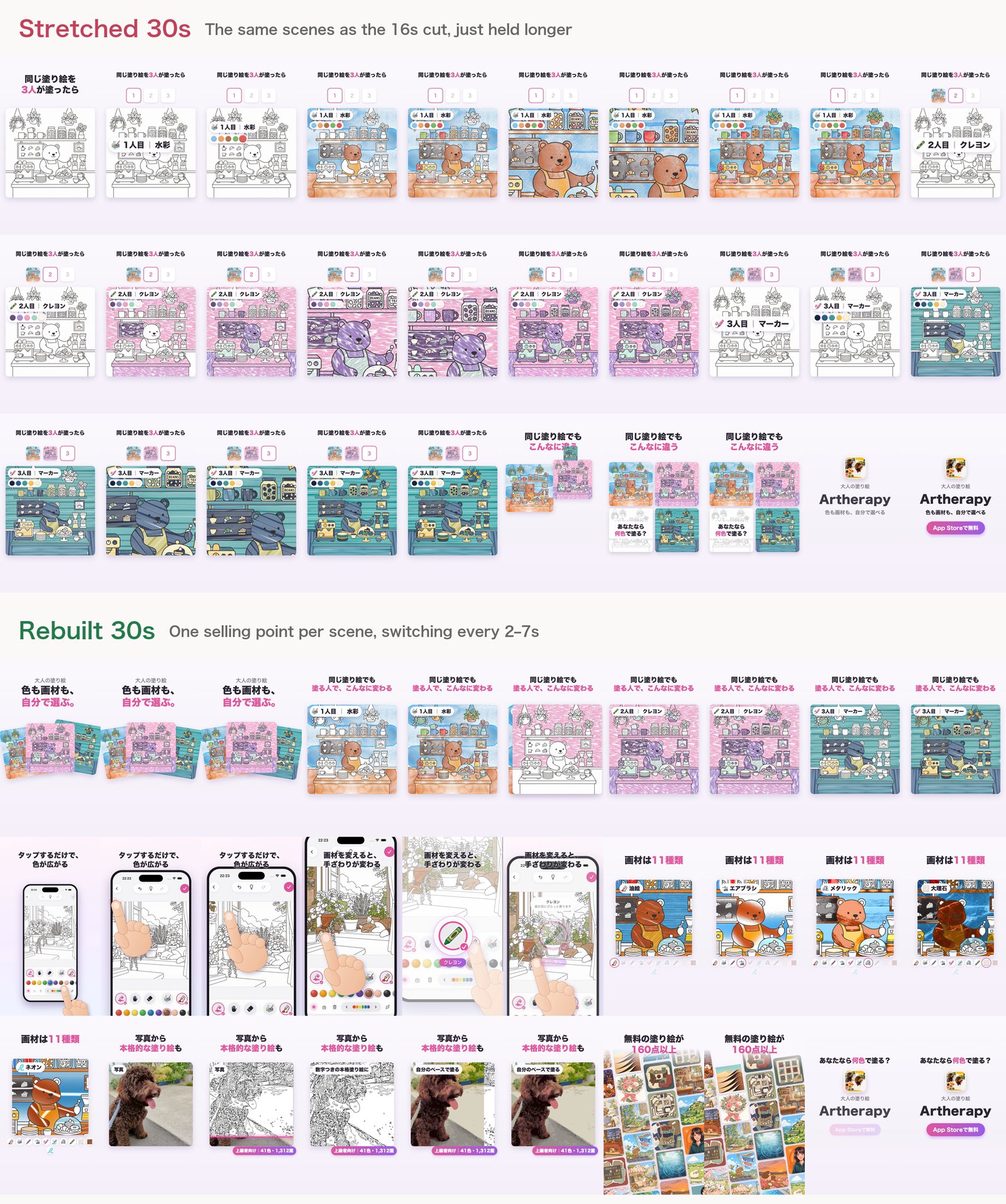
If you make it longer, show more — not the same thing slower
Koki asked for the 16-second cut to become 30 seconds for TikTok. The first 30-second version just held the same scenes longer. Koki asked for it to show other selling points instead, and it was rebuilt as one selling point per scene: choosing colors and media, tap-to-fill, 11 art media, turning a photo into a real paint-by-numbers, and 160+ free pages.
It has to work with the sound off
Lots of people watch TikTok muted, so meaning goes up front in on-screen text rather than narration. No talking-head UGC style: Koki's view is that the app's own footage — color flooding in, line art turning into a finished picture — beats AI-generated visuals.
Lines Koki won't cross
- No invented testimonials. No "my mom colors every day." Footage that just auto-applies three color schemes is labeled "3 color schemes," not "3 people colored this"
- No promised health effects. No "relieves stress" or "cures brain fatigue"
- No claims the footage can't back up. Auto-filled footage doesn't get captioned "look how much you can color in 10 minutes"
Next
Once all 18 are out, I'll post the numbers by hypothesis — and which ones Koki kept and dropped.
- #growth
- #tiktok
- #short-video
- #buildinpublic
- #ios